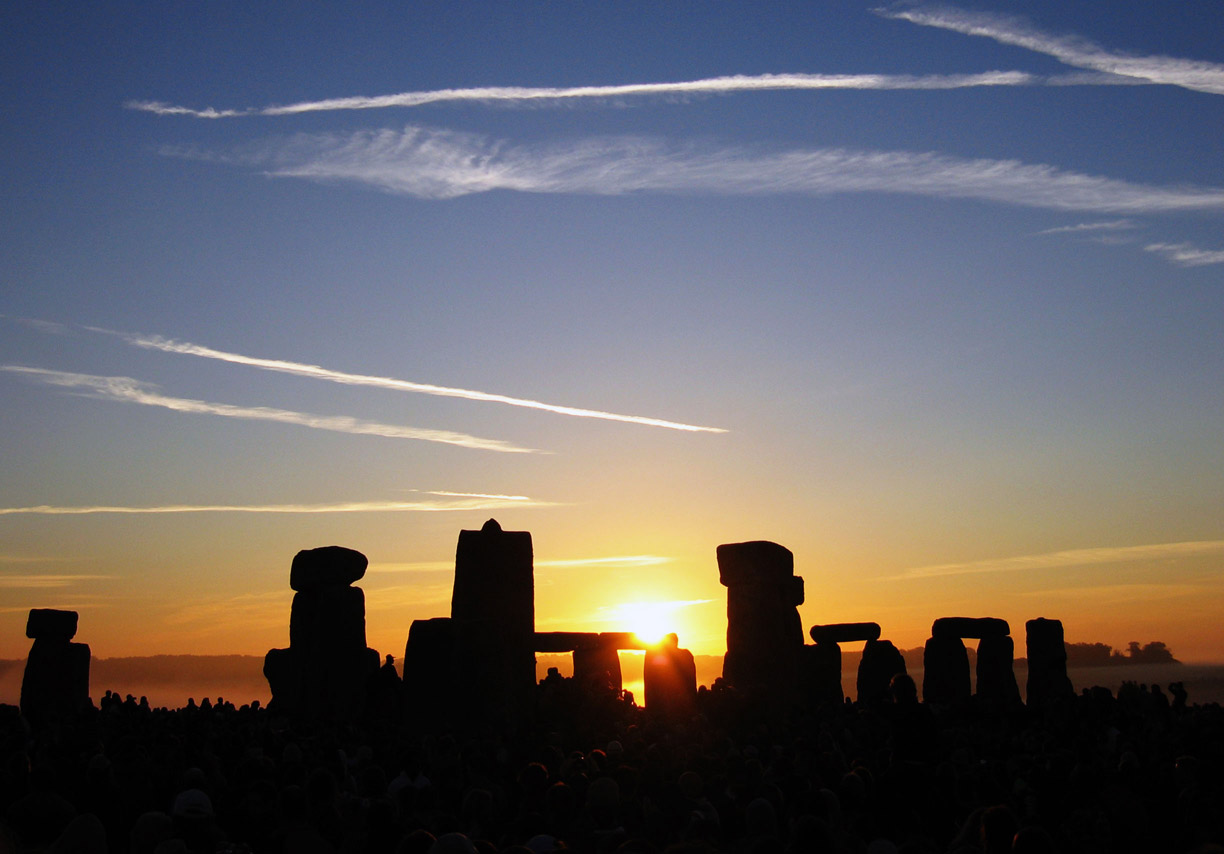
Photo: Andrew Dunn / CC BY-SA 2.0 / Wikimedia Commons
The Summer Solstice: Light, Darkness, and the Turning of the Year
June 21, 2026
When I was a teenager, I had the opportunity to spend the Summer Solstice in Edinburgh, Scotland. Besides how beautiful the city was and how friendly everyone seemed, the thing that surprised me most was how late the Sun set. I remember looking at my watch and realizing it was nearly 10:00 p.m. and still light outside.
At the time, I hadn't given much thought to latitude or the Earth's relationship to the Sun. I simply couldn't believe there was still daylight that late in the evening. Looking back now, it seems only fair that people who endure long northern winters get to enjoy some of the longest days of the year.
Here in Northern California, where I live, the Sun sets around 8:30 p.m. near the Summer Solstice. That's certainly a long day, but it feels very different. In fact, when I think of summer, the Summer Solstice has never felt like the middle of the season to me. It feels like the beginning. School was out, vacations were starting, and the hottest days were often still ahead.
But for people whose lives were more closely tied to the rhythms of nature, the Summer Solstice may have felt quite different. Farmers, shepherds, sailors, and those who worked outdoors lived in much closer relationship with the movements of the Sun and Moon. They noticed subtle seasonal shifts that many of us barely register today. Where we live, how we spend our days, and the pace of modern life all shape our relationship with the sky.
For our ancestors, however, the Summer Solstice was far more than a date on a calendar. It was a celestial event of enormous importance.
Long before smartphones, clocks, calendars, and weather forecasts, people looked to the sky to understand the rhythms of life. The movement of the Sun, Moon, stars, and planets helped determine when to plant crops, when to harvest, when to travel, and when to prepare for winter. The sky was not separate from daily life. It was the great clock by which life was organized.
The word solstice comes from the Latin solstitium, meaning "Sun standing still." Around the solstice, the Sun appears to pause its northward journey through the sky before slowly beginning its return southward. Ancient observers noticed this subtle change and understood it as a turning point in the year.
Throughout the world, civilizations built monuments aligned to the Sun's movements. Perhaps the most famous is Stonehenge. For thousands of years, people have gathered there to watch the solstice sunrise align with the ancient stones. Similar solar alignments can be found in Ireland, Egypt, Mexico, Peru, and many other places around the globe. These structures remind us that people were carefully observing the heavens long before the invention of modern astronomy.
The Summer Solstice often carried a dual meaning. It marked abundance, fertility, and the height of the growing season. Fields were green. Days were long. Life was flourishing.
Yet many cultures also recognized a deeper truth.
The longest day of the year is also the day after which daylight begins to slowly decrease.
The moment of greatest light contains the beginning of darkness.
Ancient people understood this paradox. They lived close enough to nature to recognize that every season eventually changes. Growth becomes harvest. Summer becomes autumn. Day becomes night. Nothing remains fixed forever.
And yet, standing here in Northern California, I still find it difficult to think of the Summer Solstice as the middle of summer. My summer is only beginning. The hottest days are still ahead. The gardens are still growing. The long evenings invite us outdoors.
That is the paradox of the solstice for me.
The day reaches its greatest length just as the daylight begins its slow return toward winter. Light and darkness meet in a moment of perfect balance, even as the wheel continues to turn.
This year, I think I will look up. I will pause for a moment beneath the evening sky and find some simple way to honor the solstice in my own way. Not because I am a farmer watching the seasons for survival, but because remembering our connection to the sky feels worthwhile.
After all, it is the same Sun our ancestors watched thousands of years ago.